Timing, trust and the expensive lessons behind building businesses
There is a tendency to tell business stories backwards.
Once a company grows, a partnership works or an investment pays off, the decisions that led there can start to look obvious. They rarely were.
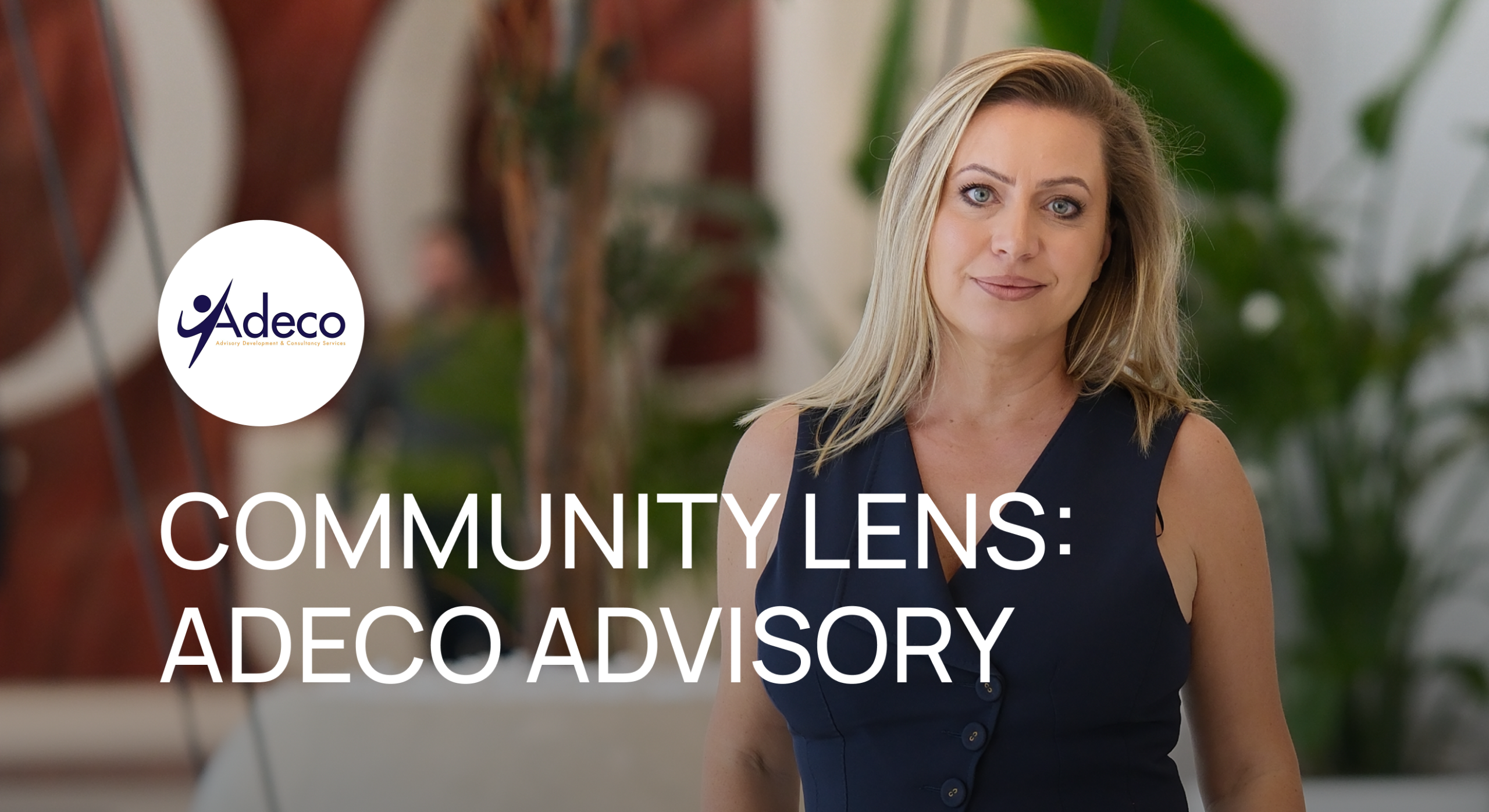
For the first edition of Supertree Community Lens, our monthly series introducing the people behind the Supertree ecosystem, we sat down with Gianina Crăciun, Founder & CEO of Supertree and Managing Partner of Adeco Advisory, our parent company, to talk about how she evaluates opportunities, why timing is a strategic capability, and the business lesson she would rather not have had to learn first-hand.
After more than 15 years across law, business development, partnerships, M&A and entrepreneurship, Gianina has worked on both sides of growth: helping companies enter markets and build businesses, while also building ventures of her own.
Here are three questions about what that experience has taught her.
Q: After 15+ years in business, what are the three principles you keep coming back to?
Gianina: The first is to understand what sits behind an opportunity, not only what is visible on the surface.
A proposal can look attractive financially and still be the wrong decision. You need to understand the incentives, interests, risks, people involved and what everyone ultimately wants from the situation. That applies to partnerships, acquisitions, hiring, investment and even clients.
The second is to invest in strategic relationships rather than simply building a large network. I have never believed that knowing more people automatically creates more opportunity. Trust, credibility and consistency compound over time. A good introduction may open a door once; your reputation determines whether that door stays open.
And the third is learning to combine ambition with discipline. Entrepreneurs naturally see possibilities everywhere. The harder skill is deciding which opportunities deserve your attention and which are simply distractions dressed as opportunities.
Growth is not only about moving faster. Sometimes the best strategic decision is to wait, sometimes it is to say no, and occasionally it is to move much faster than feels comfortable.
Q: You talk a lot about timing throughout daily operations. Can timing really be a strategy?
Gianina: Absolutely!
We often think about strategy in terms of what we want to build, where we want to compete or who we want to work with. But when can be equally important.
There is an old distinction between Kronos, chronological time, and Kairos, the right or opportune moment. I find that distinction surprisingly relevant to business.
I have seen very good ideas fail simply because the market was not ready. I have also seen ordinary-looking opportunities become extraordinary because the right people, resources and circumstances suddenly aligned.
That is also how I think about luck.
Luck is rarely completely random. Usually there has been years of preparation behind what eventually looks like one fortunate moment. Knowledge accumulated, relationships built, credibility earned, resources assembled.
Then an opportunity appears.
The skill is recognising it early enough and having enough confidence to act!
Business teaches you to prepare before the opportunity exists. Entrepreneurship teaches you that, once it appears, the window may not remain open for very long.
Timing is therefore not waiting. It is preparation, judgement and action meeting at the right moment.
Q: What is the most expensive mistake you have made in business and what did it teach you?
Gianina: I’m not sure I believe in identifying one decision as the biggest mistake.
There are certainly things I have done that, taken out of context, could easily be called mistakes. But business decisions never happen in isolation, and hindsight has a dangerous way of making the past look much more obvious than it really was.
A decision that was wrong for me in a particular market, at a particular moment, with a particular team, could be exactly the right decision for someone else. Timing matters. The market matters. The people around you matter. Your financial position matters. And, perhaps most importantly, the alternatives you have built around that decision matter.
I have always tried to approach entrepreneurship differently from a binary bet where you either win or lose everything. Before I invest, I want to understand the downside as clearly as the upside.
What happens if the original idea does not work? Can the asset be used differently? Can the model evolve? Can the business be repositioned? Is there another source of revenue?
Perhaps that is also why I have always liked real estate. There is something reassuring about investing in an asset that can usually have a second life.
That does not mean I have avoided expensive lessons.
I have trusted people who eventually proved to be very different from who I thought they were. I have entered partnerships believing we shared the same values and ambitions, only to discover that the partnership itself could become the biggest risk to the business.
That taught me something uncomfortable: sometimes a good business with the wrong partner can be worse than an average business with the right one.
I also once decided to bring an international real-estate franchise to Romania. It was a successful model abroad, there was a recognised brand behind it, and on paper the logic made sense.
So I invested.
Several hundred thousand euros later, I understood something no Excel model had fully captured: a business model that works exceptionally well in one country is not automatically transferable to another.
Consumer behaviour is different. Trust is different. The way people buy, negotiate and make decisions is different. Culture can be just as important a business variable as price, product or capital.
Was entering that business a mistake? Perhaps.
But the experience fundamentally changed the way I evaluate markets, partnerships and expansion opportunities today. It gave me knowledge I would probably never have acquired from a market study alone.
Over the years, I have come to see mistakes differently. A mistake only remains a mistake if you fail to extract anything useful from it.
If you analyse it honestly, understand which assumption was wrong and use that insight to make the next decision differently, the experience becomes an asset.
Sometimes a very valuable one.
What I find even more dangerous today is indecision.
You can see that something is no longer working, yet still convince yourself that another month might change it. You postpone ending a partnership, changing a strategy or reallocating resources.
Sometimes patience is the right choice. But sometimes waiting is simply another decision — and one with a cost that is much harder to see. Capital continues to be consumed. Opportunities are missed. Energy remains trapped in something that no longer deserves it.
So if I had to define my most expensive business lesson, it would probably not be one transaction, one investment or one number. It would be this:
Do not confuse consistency with stubbornness, and do not confuse waiting with strategy.
Make the best decision you can with the information you have. Protect the downside. Build alternatives. And when reality gives you new information, have the courage to make a new decision.
Because sometimes what looks like a wrong turn in retrospect is simply the road that puts you in a better position for what comes next.
Learn more about Gianina on gianinacraciun.com. Looking for legal or strategic support for your business? Explore Supertree in-house advisory services, powered by Adeco Advisory.
The Community Lens
Community Lens is a monthly Supertree series created to make our ecosystem a little less anonymous.
Each edition introduces 2–3 founders, executives, professionals and partners from within the community, through the decisions they have made, lessons they have learned and ideas they are currently building.
Because sometimes the person, expertise or introduction your business needs is already working a few doors away.
Want to be featured in an upcoming Community Lens? Get in touch with the Supertree team.